
What actually is a good credit score?
The general guideline is that a ‘good’ CTOS Score will fall in the range of 697 to 850. This, however, is not a hard and fast rule and does not necessarily mean a lower score is a ‘bad’ score. When banks and lenders evaluate your application for loans or new credit, they may take other factors into consideration besides your credit score.
However, having a credit score of 697 and above can be extremely beneficial for you, as most banks and credit providers would view you as a prime customer. A good credit score can increase your chances of getting a loan, get you better interest rates and speedier loan approval, among other things.
What does your score mean?
| Score | What It Means to Lenders |
 |
Excellent! You’re viewed very favourably by lenders. |
 |
Very Good! You’re viewed as a prime customer. |
 |
Good! You’re above average and viable for new credit. |
 |
Fair. You’re below average and less viable for credit. |
 |
Low. You may face difficulties when applying for credit. |
 |
Poor. Your credit applications will likely be affected. |
 |
Your score couldn’t be generated due to insufficient information. |
How is the CTOS Score calculated?
The CTOS Score is calculated based on credit information from both CCRIS and CTOS’s database. 5 factors make up the CTOS Score:
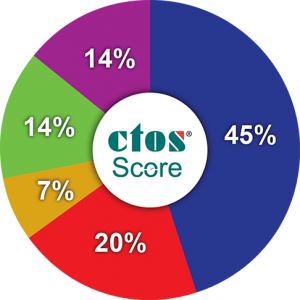 |
 Payment History (45%) Payment History (45%)Whether you pay your loans on time or have missed payments in the past |
 Amounts Owed (20%) Amounts Owed (20%)The number of credit facilities and the amount owed to the banks |
|
 Credit History Length (7%) Credit History Length (7%)How long have you held a credit facility (credit card, or a loan) |
|
 Credit Mix (14%) Credit Mix (14%)Types of loan and credit cards you hold – secured (home, car loans) vs unsecured credit (credit cards, personal loans) |
|
 New Credit (14%) New Credit (14%)Have you been approved for new credit facilities recently |
|
Sources: Banking Payment History [derived from CCRIS, Bank Negara Malaysia], CTOS Database [Legal records & Trade References]. |